Long-term Health Risk of Air Quality
The EPD has taken a health risk-based approach to assess the long-term air quality of Hong Kong that would better reflect the impact of air quality on members of the public. This approach makes reference to the methodology developed by a research team in Hong Kong. While the AQHI provides information about the risk of short-term exposure to air pollutants, the “long-term health risk of air quality” provides information about the risk of long-term exposure to air pollutants. The air quality of Hong Kong has significantly improved in recent years both in terms of air pollutants concentrations and their health risks.
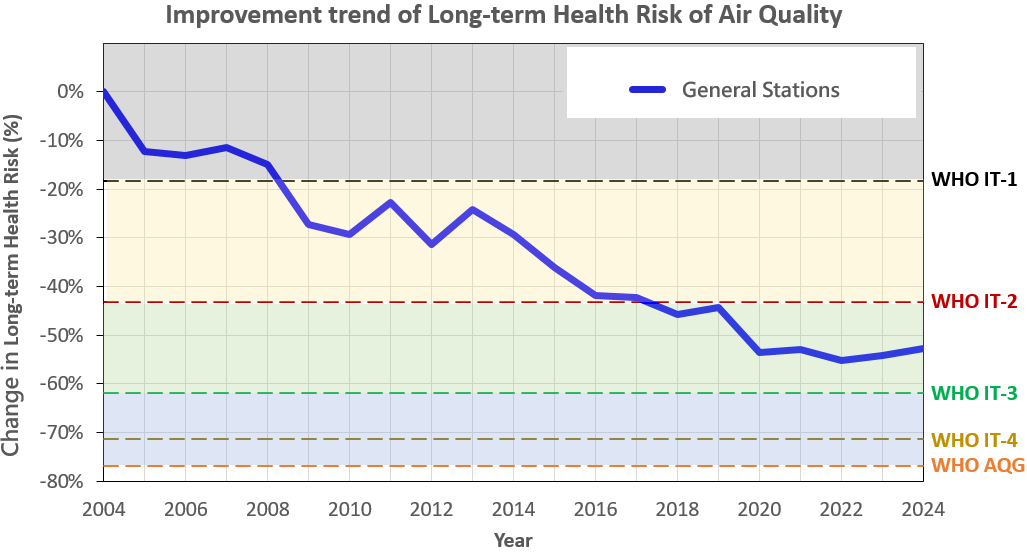
Remark: The lines of WHO IT-1, IT-2, IT-3, IT-4 and AQG represents the health risk equivalent to the interim
and ultimate targets of World Health Organization Global Air Quality Guidelines 2021 version.
The Long-term Health Risk of Air Quality is calculated from the sum of the added health risks (%AR) attributable to the peak season concentration of ozone (O3) and the annual average concentrations of nitrogen dioxide (NO2) and particulate matters (PM10 or PM2.5, whichever poses a higher health risk).
The equations are as follows:
%AR = %AR(NO2) + %AR(O3) + %AR(PM) where %AR(PM) = %AR(PM10) or %AR(PM2.5), whichever is higher%AR(NO2) = [exp(β(NO2) × C(NO2)) – 1] × 100%
%AR(O3) = [exp(β(O3) × C(O3)) – 1] × 100%
%AR(PM10) = [exp(β(PM10) × C(PM10)) – 1] × 100%
%AR(PM2.5) = [exp(β(PM2.5) × C(PM2.5)) – 1] × 100%
where %AR(NO2), %AR(O3), %AR(PM), %AR(PM10) and %AR(PM2.5) are the added health risk of NO2, O3, PM, PM10 and PM2.5 respectively;
C(NO2), C(PM10) and C(PM2.5) are annual average concentrations of the respective pollutants in microgram per cubic meter (µg/m3).
C(O3) is the peak season ozone (O3) concentration in microgram per cubic meter (µg/m3)*.
β(NO2), β(O3), β(PM10) and β(PM2.5) are long-term health risk factors (technically known as regression coefficients) of the respective pollutants.
β(NO2) = 0.0019802627; β(O3) = 0.0009950331; β(PM10) = 0.0039220713; β(PM2.5) = 0.0076961041
*Remark: The WHO Global Air Quality Guidelines of 2021 version defined peak season O3 concentration as “average of daily maximum 8-hour mean O3 concentration in the six consecutive months with the highest six-month running-average O3 concentration”.